
Category Archives: Heritage at Risk Register

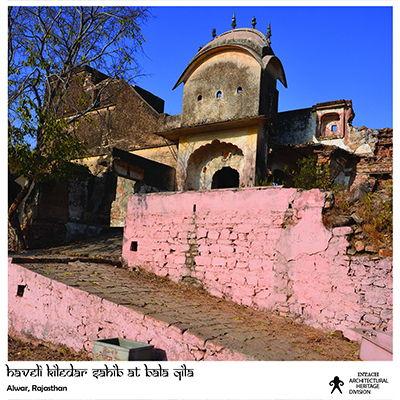
H@R 182/365 Haveli Kiledar Sahib at Bala Qila Alwar, Rajasthan
bldg 1

H@R 182/365

Haveli Kiledar Sahib at Bala Qila Alwar, Rajasthan

1828 CE. Though the main palace is ASI-protected, some structures of Alwar Fort are unprotected. The haveli is situated opposite the main palace building and it opens up into the forest. The fort was previously used to mark the state boundary for surveillance and this haveli was a rest house for the main palace guard. In the recent past, the palace was used by the police as their main wireless post but this haveli is unused. Haveli shows signs of damage and decay, and some portions are at risk of collapse.
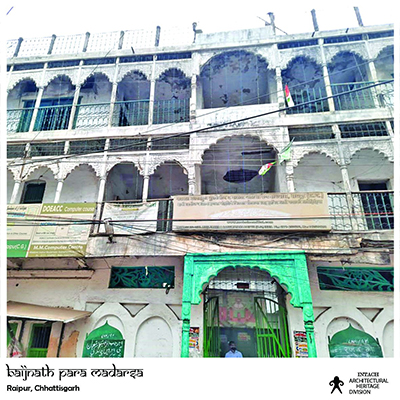
H@R 181/365 Baijnath Para Madarsa Raipur, Chhattisgarh

bldg 1

H@R 181/365

Baijnath Para Madarsa Raipur, Chhattisgarh

The Madarsa is located in Baijnathpara in Raipur. It dates to 1924 CE. The building is facing deterioration and shows signs of structural threats. Algae growth and dampness are also visible. There are hardly any direct incentives available for conservation. In general for built heritage, the expectation of preservation, maintenance and financial resources is from government departments. An array of financial incentives must be devised for owners, exploring opportunities for practical, creative solutions and linkages. Linkages are definitely possible with schemes of various sectors for incentivising conservation of historic properties.

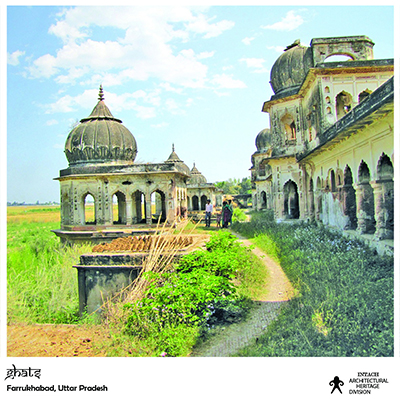
H@R 180/365 Ghats Farrukhabad, Uttar Pradesh

bldg 1

H@R 180/365

Ghats Farrukhabad, Uttar Pradesh

Farukkhabad emerged as an important town in the 18th century in northern India. It became a great centre of commerce and trade. The Bangash Nawabs encouraged merchants and bankers to come and settle in Farrukhabad. The ghats consist of a cluster of highly dilapidated structures, gateways, pavilions and garden complexes. The water has receded completely. Unprotected built heritage of such significance requires proactive steps by authorities before they are lost permanently.

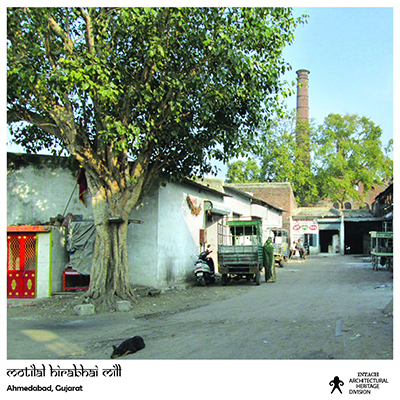
H@R 179/365 Motilal Hirabhai Mill Ahmedabad, Gujarat

bldg 1

H@R 179/365

Motilal Hirabhai Mill Ahmedabad, Gujarat

Location: Telia Mill, Prem Darwaja, Ahmedabad. The mill is from 1889 and was an industrial building during Revival of Ahmedabad. It is severely threatened and partially collapsed. Such erstwhile mill buildings are remnants of an industrial economy that lived their age of optimum production, and have outlived their utility. They present an opportunity for repurposing their use to address the current requirements of the neighbourhoods they are located in. Adaptive reuse not only provides creative prospects for design, but also responds positively to the environmental challenges posed by demolition and new construction.

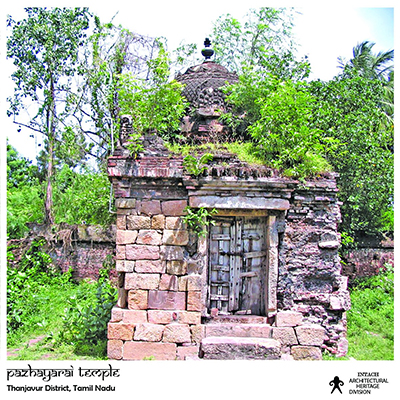
H@R 178/365 Pazhayarai Temple Thanjavur District, Tamil Nadu

bldg 1

H@R 178/365

Pazhayarai Temple Thanjavur District, Tamil Nadu

Dating to 8th to 9th century CE. Pazhayarai was the Chola Capital much before Tanjore. This is where Great Raja Raja Chola also spent his early age. The site is in a deplorable state. What exists is just a part of the lost city in wait of excavation. This is an example of heritage at risk owing to neglect and apathy.

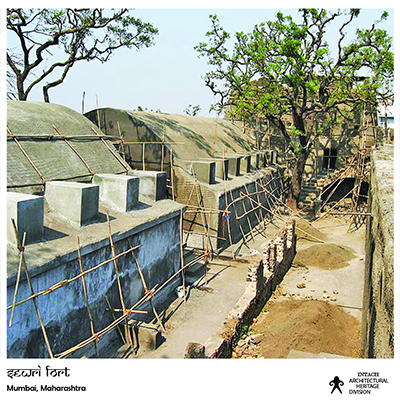
H@R 177/365 Sewri Fort Mumbai, Maharashtra

bldg 1

H@R 177/365

Sewri Fort Mumbai, Maharashtra

Not many are aware of the existence of Sewri fort at Mumbai, which dates from about 1680 CE. Since it is a desolate area, it is vulnerable to anti-social elements. Located near the Sewri railway station, the fort cannot be easily spotted by passersby, owing to concrete buildings obstructing the view from the road. Signage is lacking. Sewri Fort premises are in a state of deterioration and neglect.

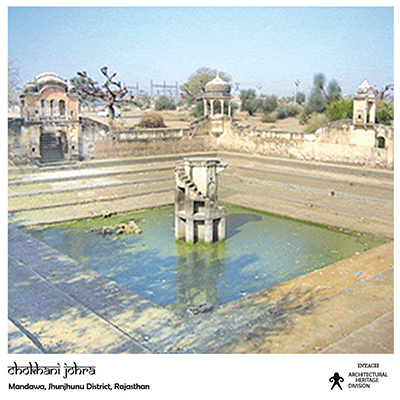
H@R 176/365 Chokhani Johra Mandawa, Jhunjhunu District, Rajasthan

bldg 1

H@R 176/365

Chokhani Johra Mandawa, Jhunjhunu District, Rajasthan

Chokhani Johra is situated in Mandawa in Jhunjhunu District. It dates from 1845 CE. The historic water structure shows signs of deterioration. Sikar and Jhunjhunu districts of Rajasthan are dotted with step-wells, however, in the past decade the water table has drastically depleted and most of them are defunct today. INTACH undertook identification and mapping of traditional water structures of Rajasthan in 2015.

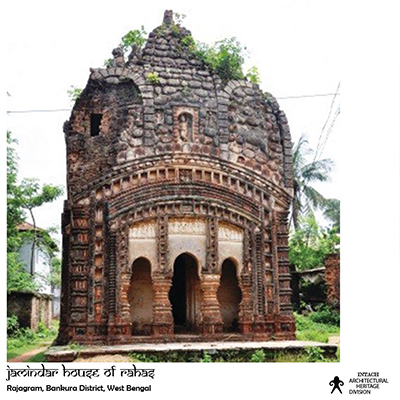
H@R 175/365 Jamindar House of Rahas Rajagram, Bankura District, West Bengal

bldg 1

H@R 175/365

Jamindar House of Rahas Rajagram, Bankura District, West Bengal

About 200 years old complex of Rajbari, Rasmanch and temples is located in Joypur Block, Bankura District. It has stucco work and unique terracotta ornamentation (to appear like rubble masonry). There exists a combination of European and vernacular styles. This built heritage is managed and owned by extended joint family but lack of financial means and technical input are putting the structures at risk. Old mansions are in ruins. Such historic buildings under private ownership face challenges of finance and technical expertise, which are the major factors for the present status of conservation.

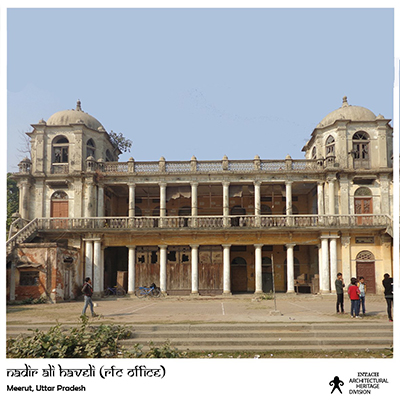
H@R 174/365 Nadir Ali Haveli (RFC Office) Meerut, Uttar Pradesh

bldg 1

H@R 174/365

Nadir Ali Haveli (RFC Office) Meerut, Uttar Pradesh

Nadir Ali Haveli is located at Sher Garhi Road, Rambagh Colony, Meerut. It is in use as the Regional Food Controller’s Office. It is owned privately and given on lease to UP State Government. The 150 years old building is in an advanced state of decay and needs appropriate maintenance. The decorative elements are also in a damaged condition. Many government departments and authorities own heritage structures but lack expertise in maintenance and a scientific approach to conservation of their built heritage. By increasing their capacities and awareness, a large part of the historic building stock would be preserved through appropriate maintenance, repair and in cases, conservation where needed.

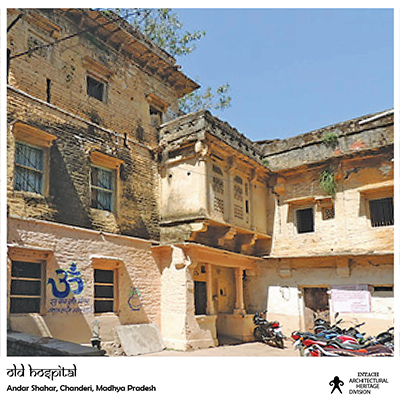
H@R 173/365 Old Hospital Andar Shahar, Chanderi, Madhya Pradesh

bldg 1

H@R 173/365

Old Hospital Andar Shahar, Chanderi, Madhya Pradesh

Origin of this unprotected structure likely dates to the 15th century CE. It was modified as a hospital in the 18th century during the reign of the Scindias. The structure has been declared unfit for use by the Public Works Department and lying derelict for the last few years. However, it needs to be re-examined and retrofitted for appropriate reuse. Despite many plans being developed for Chanderi over the years, the lack of implementation on recommendations has resulted in the present condition of the historic buildings. There is a disconnect between planning and execution authorities, coupled with absence of public participation.