
Category Archives: Heritage at Risk Register

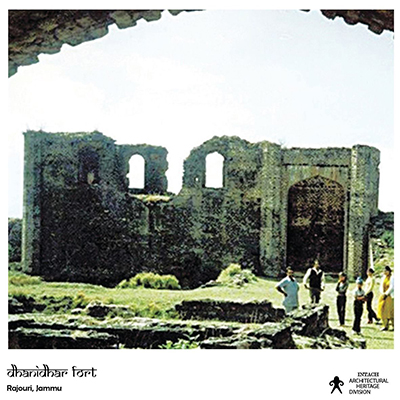
H@R 152/365 Dhanidhar Fort Rajouri, Jammu
bldg 1

H@R 152/365

Dhanidhar Fort Rajouri, Jammu

The fort was completed in 1855 CE. Other than the main intent of construction as a fort structure, it was also used to store grains collected from the farmers as revenue. Dhanidhar Fort, Rajouri district was used by defense personnel, but now the fort is in poor condition and ruins. A telecom company has installed a tower in it. The concerned agencies need to make effort to establish an approachable road to it and undertake measures for preservation. Picture Source: www.kashmirtourism.org
H@R 151/365 Havelis and their wall paintings Shekhawati, Rajasthan

bldg 1

H@R 151/365

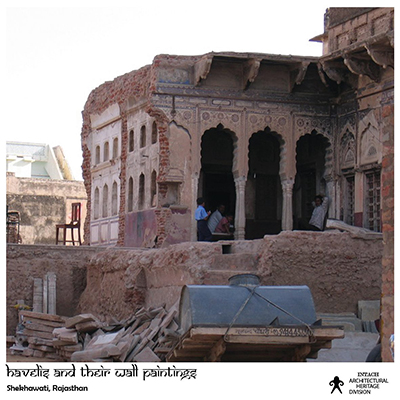
Havelis and their wall paintings Shekhawati, Rajasthan

1830-1930 CE. Painted havelis of Shekhawati are being obliterated either through neglect or reconstruction. Havelis often face threat of demolition for real estate speculation, and at times are disintegrated insensitively for incorporating other uses. These traditional residential buildings date back to old generations of business families from the area and today have multiple owners settled in different parts of the country. Thus neither outright takeover for maintenance of the best places is possible nor are the residents bound by any law to restore and preserve these old edifices.

H@R 150/365 Fortification Walls, Ahmedabad

bldg 1

H@R 150/365

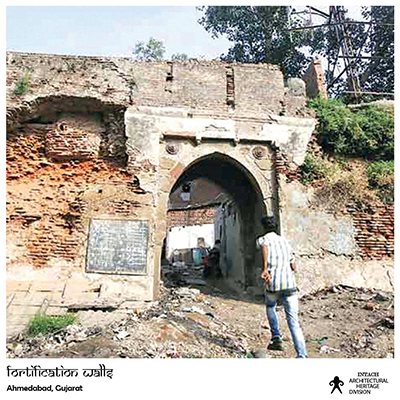
Fortification Walls, Ahmedabad

As we post the 150th site from INTACH SoBHI Heritage at Risk Register, we would like to reiterate the intent of this social media campaign that was launched on World Heritage Day, 18th April 2021. This is to bring attention to the lesser known unprotected built heritage of India, such as the site posted today that is left to neglect. Assistance is sought from the public so that conservation can be facilitated, either by providing a connect with the local community/ authorities, or by raising awareness campaigns leading to generating funds/ help in kind. Collaborations are encouraged, to make a difference to save India’s built heritage. Initiatives can be taken up by private/ corporate/ government bodies with the local community. Suggestions or updates on the sites can be sent to heritage.risk@gmail.com A stretch of about 800 metre long fort wall (behind Lal Darwaza, old city centre, Ahmedabad) and fortification walls, Kadi Town, Daskroi Tal are in an advanced stage of decay. These form part of the 15th century CE fort wall that defined the boundaries of Ahmedabad during the rule of Ahmed Shah, as well as Maratha period fortification. Lack of maintenance has led to masonry decay. Municipal Corporation (AMC) has built the riverfront near the old fort wall. Trees have grown out of the historic wall, breaching through its two metre thick breadth.

H@R 149/365 Purani Kachehri Chanderi, Madhya Pradesh

bldg 1

H@R 149/365

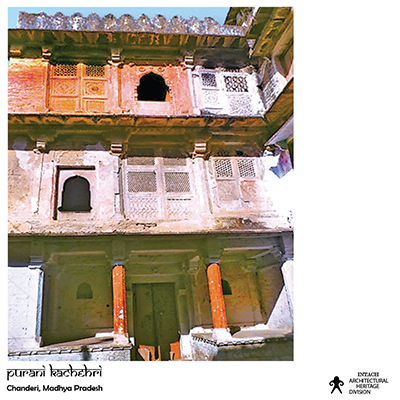
Purani Kachehri Chanderi, Madhya Pradesh

The building which would have been the old court, is located in Andar Shahar, Chanderi. It dates from 17th century CE. The structure was declared unfit for use by the Public Works Department several years ago. However, it needs to be re-examined and retrofitted for appropriate reuse. There is dearth of action on such valuable built heritage, which leaves them derelict and susceptible to further decay in the absence of any maintenance.

H@R 148/365 Ruins of Mosque Panipat, Haryana

bldg 1

H@R 148/365

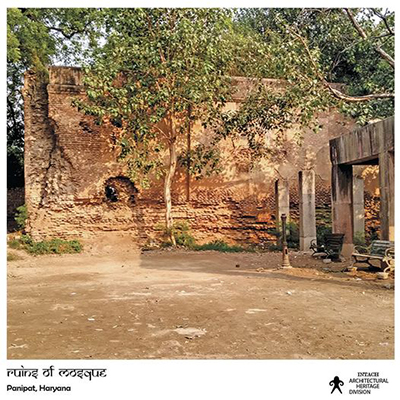
Ruins of Mosque Panipat, Haryana

The mosque is from 16th-17th century CE. It is in ruins and is in danger of disappearance. Panipat has a range of built heritage typologies that are in varying conditions; some date from Sultanate, late Lodhi and Mughal periods. In the civic and defense buildings that are in use, modifications (i.e. additions, alterations, expansions) are by and large undertaken with materials that are incompatible with the historic fabric. An example is a historic gateway in Panipat – Bu Ali Shah Darwaza which has a vaulted ceiling in lakhori bricks. It is in a state of distress and facing encroachments.

H@R 147/365 Rizwan Castle Patna, Bihar

bldg 1

H@R 147/365

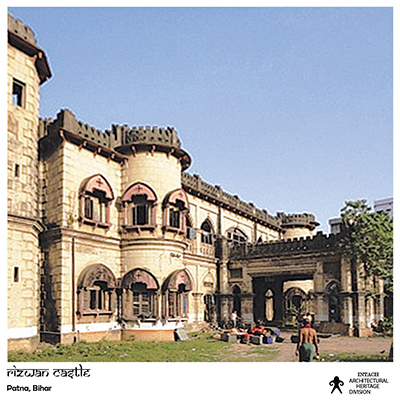
Rizwan Castle Patna, Bihar

Dak Bungalow Chouraha stands at the intersection of the historic Bailey Road, Fraser Road and the Dak Bungalow Road, all three names still prevalent, even though post-Independence the street names were changed. On Fraser Road, dubbed the ‘Fleet Street of Patna’, were located, besides the Dak Bungalow, some of the finest houses, mansions, kothis and palatial houses, most of which were lost to the real estate boom. Opposite the Dak Bungalow was the iconic ‘Rizwan Castle’, perhaps the only specimen of a Tudor castle built in the 1920s in Bihar by Hasan Imam, which has fallen to apathy and reduced to a dilapidated state. The condition of ‘Sultan Palace’ built in the same era by Sir Sultan Ahmad, the legendary barrister has been reduced to a poorly maintained government office.

H@R 146/365 Gateway and Shops Bausadwada, Diu

bldg 1

H@R 146/365

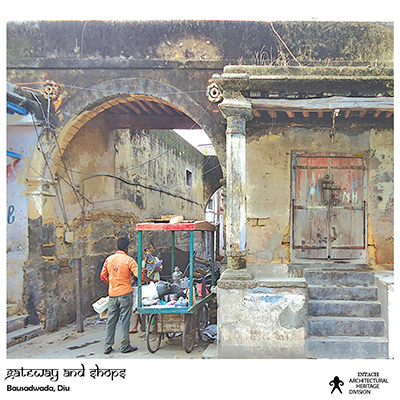
Gateway and Shops Bausadwada, Diu

Located at Punja Gali, Bausadwada, Diu. The 18th century CE building is covered with vegetation growth. Wooden members have decayed due to dampness and algae growth. Peeling of plaster is also noted. Dampness is one of the major issues for the decay of heritage structures in Diu. It results in biological growth (algae and vegetation) and structural issues in the buildings.

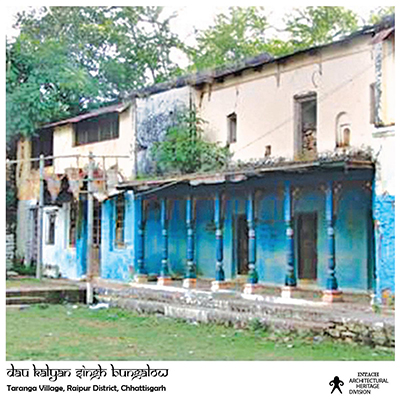
H@R 145/365 Dau Kalyan Singh Bungalow Taranga Village, Raipur District, Chhattisgarh

bldg 1

H@R 145/365

Dau Kalyan Singh Bungalow Taranga Village, Raipur District, Chhattisgarh

About 150 years old. Established by Dau Kalyan Singh during the British rule, it served as a place of stay for visiting kings, queens and British officers and dignitaries. The building is abandoned and many portions have already collapsed. Nearly every part has deteriorated with time.

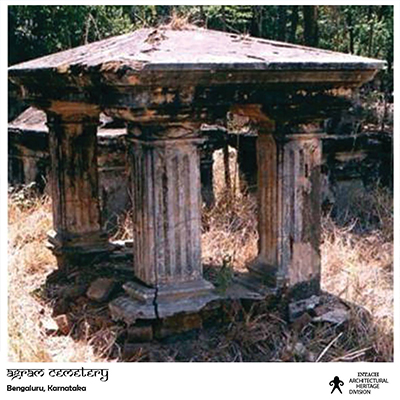
H@R 144/365 Agram Cemetery Bengaluru, Karnataka

bldg 1

H@R 144/365

Agram Cemetery Bengaluru, Karnataka

Located at lower Agram Road, Bengaluru. Under the Army area, not accessible to public. There were several graves dating as far back as 1808, after the cantonment was shifted to Bangalore in 1806 from Srirangapatnam. The site is of about 4.87 acres and has 824 graves including many great men, soldiers, wives, children and pastors. It contained interesting cenotaphs and epitaphs. The Cemetery was disused from around 1870, and was abandoned after the 1920s. It is not maintained and is in ruins. The site is under threat due to vegetation growth and water-logging. Even if structures are not restored, the landscape, including drainage, should be done on top priority.

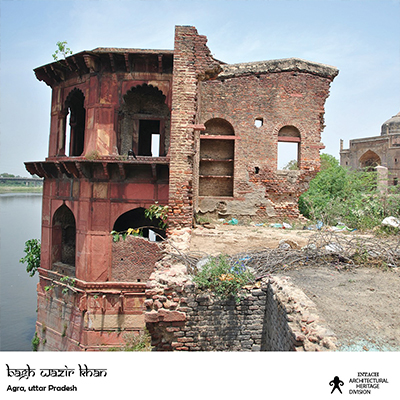
H@R 143/365 Bagh Wazir Khan Agra, Uttar Pradesh

bldg 1

H@R 143/365

Bagh Wazir Khan Agra, Uttar Pradesh

Bagh Wazir Khan is located south of Chini Ka Rauza and can be reached after crossing Katra Wazir Khan, Yamuna Bridge Road. Bagh Wazir Khan was built by Afzal Khan, Wazir of Shah Jahan. It was designed as a small garden facing the Yamuna. Very less of the garden now remains, it once consisted of two corner octagonal turrets and a central pavilion structure. There are also signs of an archway below the ground level. The structure is in ruins now. Only a three-arched gateway of the pavilion is remaining along with the burjs.