
Category Archives: Heritage at Risk Register

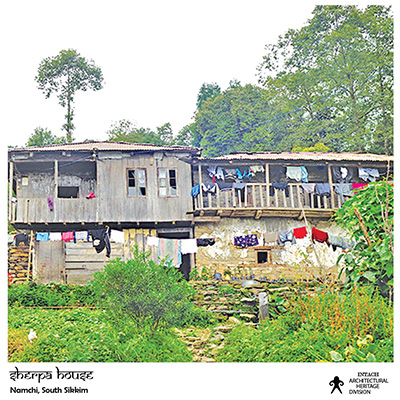
H@R 121/365 Sherpa House Namchi, South Sikkim
bldg 1

H@R 121/365

Sherpa House Namchi, South Sikkim

The house is located on a ridge in Deu Village, Simkhalka, Damthang-Rabongla Road, Namchi, South Sikkim. This is one of the few remaining buildings which still retain their original character with the least transformations. The original house was completely built-in stone in 1930 CE. A new extension of the house was built in the 1960s to accommodate the extended family. The newer building is constructed in timber and has a stone plinth. The lower area is used for storage in both structures. Water-logging and dampness is damaging the stone walls as well as timber walls. It is in an advanced state of decay.
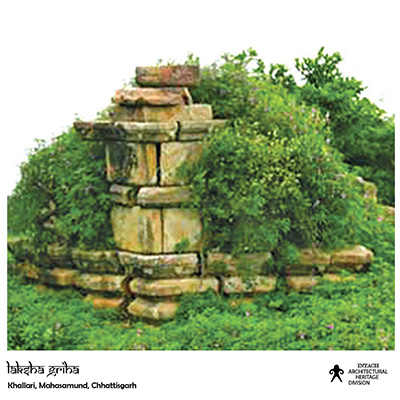
H@R 120/365 Laksha Griha Khallari, Mahasamund, Chhattisgarh

bldg 1

H@R 120/365

Workshop Bausadwada, Diu

Lakshagriha is an intriguing structure situated in the Khallari village of Mahasamund. Even though it is on the verge of disappearance, it is an iconic structure, attributed to the Mahabharata era. A temple-like structure, said to have been made opposite the Lakshagriha mentioned in the Mahabharata – it is believed that this is the location where the tunnel started, which led the Pandavas under the hill and helped them flee. At present it is in a very poor condition. Enveloped by heavy vegetation, many parts of the structure are now buried. The roof has collapsed and the remaining parts are in danger of disappearance.

H@R 119/365 Palace of local Raja Ajaigarh, Panna District, Madhya Pradesh

bldg 1

H@R 119/365

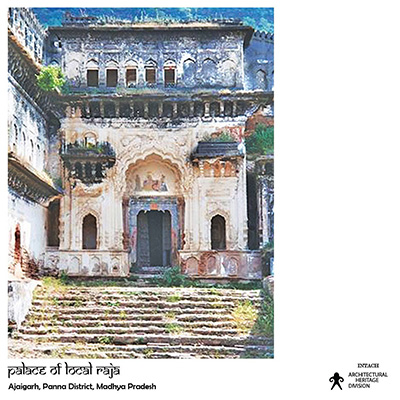
Palace of local Raja Ajaigarh, Panna District, Madhya Pradesh

The palace dates from 17th to 19th century CE. It is in a ruinous state. With clearly visible signs of deterioration, it is an example of indifference. A newer inhabited palace is built behind the valley. Above, on the hillcrest, are the neglected ruins of Ajaigarh Fort, reached by a rough trail. Owing to the enormity of scale, the maintenance of forts and palaces is generally demanding for owners. The lifespans of the structures of this unique built heritage typology can be increased by their continued usage. Even if partial adaptation of the space is undertaken for reuse, it can contribute to the structure’s upkeep and self-sustainability.

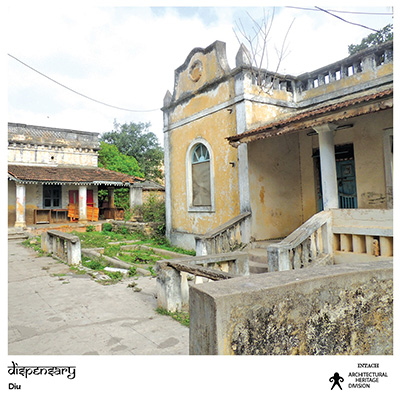
H@R 118/365 Dispensary Diu

bldg 1

H@R 118/365

Dispensary Diu

The dispensary building dates from 1909 CE. It is located at the corner of Kelkar Road, Diu. The building is facing issues of weathering, dampness and peeling of plaster and paints. Owners and users need to be made aware of their unique heritage. Since a large part of the built heritage is privately owned, financial assistance and technical assistance would act as a boon in the conservation of private properties.

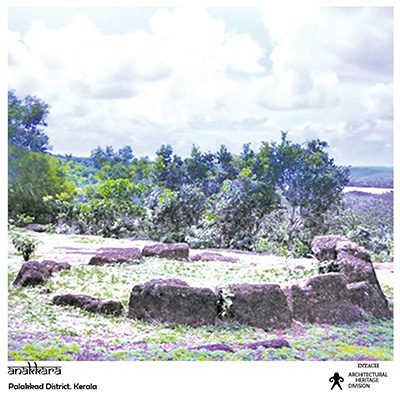
H@R 117/365 Anakkara Palakkad District. Kerala

bldg 1

H@R 117/365

Anakkara Palakkad District. Kerala

The site of Anakkara in Palakkad District, Kerala is a megalithic burial site that has megalithic burials of the Iron Age – Early Historic period. Microliths are also found here sparsely. The 2000 years old archaeological site is partly destroyed. The site is private property and some of the burials here could be protected and preserved with the cooperation of the local people.

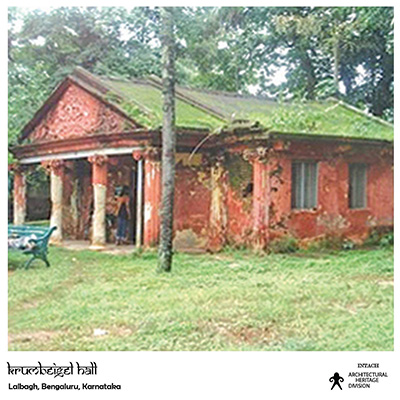
H@R 116/365 Krumbeigel Hall Lalbagh, Bengaluru, Karnataka

bldg 1

H@R 116/365

Krumbeigel Hall Lalbagh, Bengaluru, Karnataka

Built around 1860 and also referred to as Horticulture Lecture Hall, it was renamed in honour of Gustav Krumbiegel, superintendent of Lalbagh from 1908 to 1932. It is built in classic Greek style. The columns (alders) are in typical Corinthian style and have triangular pediments above. This prominent heritage resource is in poor condition due to unsympathetic repairs, neglect and lack of funds. The abandoned structure is in an advanced state of decay. There is a great potential for capacity building within the area and as a resource for other heritage areas. Engineers from PWD and BBMP, with a large number of public buildings of historic importance under their jurisdiction, need to be made aware of traditional materials and their use for repair and conservation. There is an interest within individual contractors for increasing their skills in this area.
H@R 115/365 Rani Mangammal Palace Madurai, Tamil Nadu

bldg 1

H@R 115/365

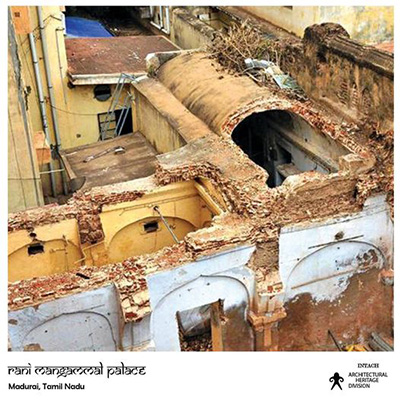
Rani Mangammal Palace Madurai, Tamil Nadu

The palace dates from 1670 CE. The demolition of a portion of the Rani Mangammal Palace at Madurai is an example of the threat faced by unprotected heritage structures. The palace is maintained by the Public Works Department while portions of the structure on the rear side are claimed by many as private property, and demolished. There is enough evidence that several structures which were once part of the palace were demolished to house new buildings on North Avani Moola Street.

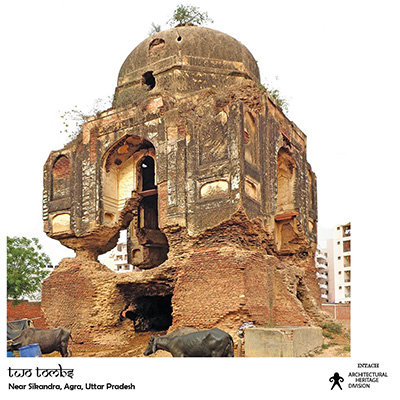
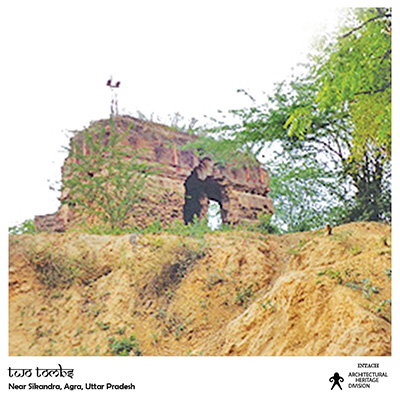
H@R 55/365 Two Tombs Near Sikandra, Agra, Uttar Pradesh

bldg 1
bldg 1

H@R 55/365

Two Tombs Near Sikandra, Agra, Uttar Pradesh

Two tombs are located nearly 500m to the west of Kaanch Mahal, Sikandra, Agra. They are from mid-16th century CE and in danger of disappearance, despite being situated near a much visited site. In the tourist destination Agra, due to the presence of a large number of protected monuments including 3 world heritage sites, the other heritage properties are ignored by the administration in terms of investment in their repair, maintenance and access. Owing to the insensitive attitude of the authorities and society, these sites become dump yards and are partially or completely transformed. Encroachment and vandalism are major concerns for unprotected heritage properties.

H@R 114/365 Records Block & abandoned structure District & Sessions Court Complex, Ambala, Haryana

bldg 1

H@R 114/365

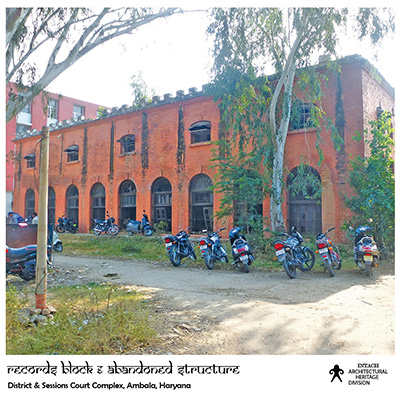
Records Block & abandoned structure District & Sessions Court Complex, Ambala, Haryana

Located in Patti Achrjan, Ambala, the historic structures are over 100 years old. Poor maintenance is common in civic buildings. Often these buildings are not considered heritage by those using them as office spaces or other purposes. Thus the low prioritization of allocation of funds stems from indifference and lack of awareness regarding the historic building. District and Sessions Court Complex, Ambala is an example where the Records Block is in a dilapidated state and declared unsafe by PWD. The abandoned structures in the complex are in an advanced state of decay. There is much scope of generating awareness towards conservation in civic bodies, especially regarding working with sensitivity towards architectural heritage, the use of compatible materials and preserving unique features.
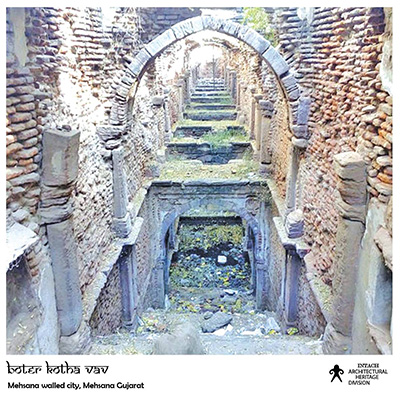
H@R 113/365 Boter Kotha Vav Mehsana walled city, Mehsana

bldg 1

H@R 113/365

Boter Kotha Vav Mehsana walled city, Mehsana

Boter Kotha Vav is a brick construction, 4-storeyed liner type of Nanda stepwell. It is severely threatened. Uncountable historic water structures have been lost to neglect and rapid urbanisation. A wide variety of traditional water harvesting, storage and water supply structures and systems have been functional across the country since centuries and known by various colloquial terms in different areas. Yet, there is a trending disregard for them and the most common state of water structures is there use as garbage dumps. With the continuing pace of insensitive development, this abundance of Vavs of Gujarat, that we so intrinsically associate with the region and take for granted, will not be part of our setting in the recent future.