
Category Archives: Heritage at Risk Register

H@R 12/365 Buddhist Monasteries, Mangyu, Ladakh
bldg 1

H@R 12/365

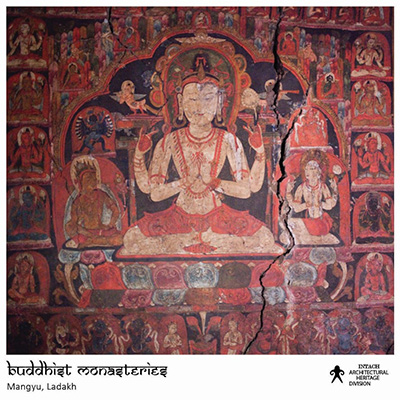
Buddhist Monasteries, Mangyu, Ladakh

One of the oldest monasteries built between 11th and 12th centuries. It is one of the rare sanctuaries where mural paintings and stucco sculptures are contemporary to the foundation of the temple. Extant examples of Indo-Tibetian art. It is important not only for archaeological and historical reasons, but also for artistic and architectural value. Undergoing deterioration and structural damage.
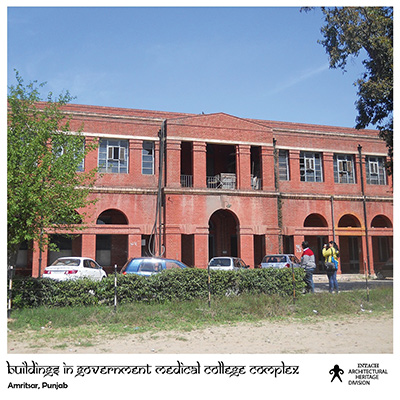
H@R 11/365 Buildings in Government Medical College complex Amritsar, Punjab

bldg 1

H@R 11/365

Buildings in Government Medical

College complex Amritsar, Punjab

Government Medical College has a large complex with a number of buildings dating back to early 20th century. These form a part of our civic built heritage. However, buildings such as these are fast deteriorating due to lack of maintenance. Abandoned structures are in danger of collapse. Often, the low prioritization of allocation of funds for unprotected historic buildings stems from indifference and lack of awareness regarding built heritage.

H@R 3/365 Shiv Temple at Rajanawa Gaon

bldg 1

H@R 3/365

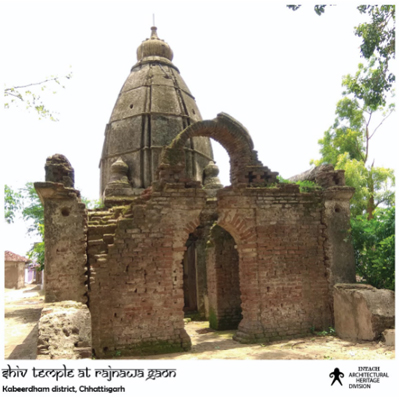
Shiv Temple at Rajanawa Gaon

Kabeerdham district, Chhattisgarh

Built in 1855 CE by Maharaja Thakur Singh during the brief period that Kawardha state capital was shifted to Rajnawa Gaon (and that is how the village was named). During the British Raj, Kawardha State was one of the princely states of the Eastern States Agency. The temple continues to be in use and hold high significance for the local community, despite being in a state of structural distress and partial collapse. It is at risk of complete collapse, with failure of the brick vaulted roof, major structural cracks and detachment of the free-standing walls.

H@R 10/365 Kotakonda Gadhi (Fort)

bldg 1

H@R 10/365

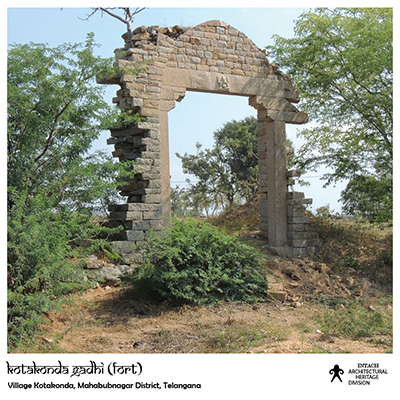
Kotakonda Gadhi (Fort)

Village Kotakonda, Mahabubnagar District, Telangana

The fort was owned by the zamindar family of Pramilla Reddy. The present village of Kotakonda was once a part of Gadhi Lokayapalli Samsthanam. This was the entrance gateway to village Kotakonda, along which a new road has been constructed. The remnants of the gateway stand out in the ruins and one can only imagine the grandeur of the fort. Besides this, there are few bastions of the fort wall remaining in this area.

H@R 1/365 Nawab Alaf Khan ki Bawri

bldg 1

H@R 1/365

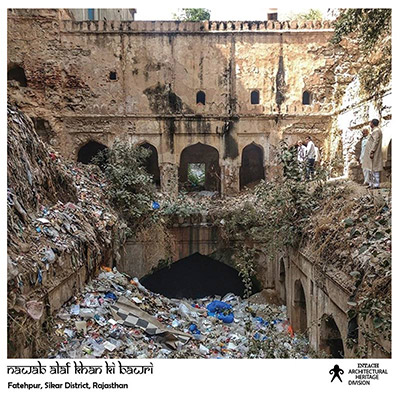
Nawab Alaf Khan ki Bawri

Located in Fatehpur, Sikar District, Rajasthan.

Six-level bawri constructed in 1614 by Sheikh Mohammed of Nagaur during the reign of Daulat Khan.

Is in an advanced state of dilapidation and completely filled with garbage (construction debris as wells as hazardous waste from the adjoining hospital). Unfortunately this is the condition of numerous stepwells across the country, that are now used as garbage dumpyards.

H@R 9/365 Inspection Bungalow Thiak, Aizawl district, Mizoram

bldg 1

H@R 9/365

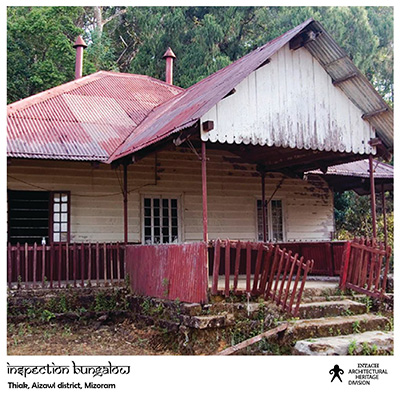
Inspection Bungalow

Thiak, Aizawl district, Mizoram

Government and public buildings such as the Inspection Bungalow represent the built heritage typology prevalent in the region during British colonial era. Unprotected historic buildings such as these are often neglected, and many a times not considered heritage by owners or users. Therefore they face low prioritization and poor maintenance. Increasing pressure on land in the wake of modern development throughout the state is an issue of prime concern. Rapid deforestation adds to the challenges.

H@R 8/365 Wadas and vernacular homes of saree weavers

bldg 1

H@R 8/365

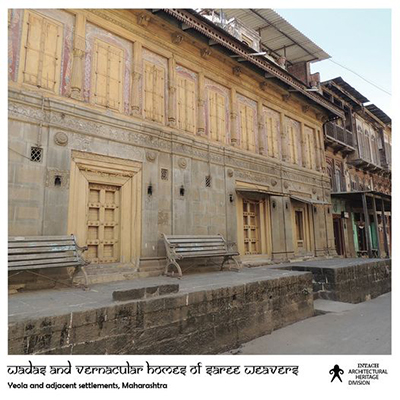
Wadas and vernacular homes of saree weavers

Yeola and adjacent settlements, Maharashtra

Yeola and adjoining villages are famous for producing the exquisite hand-woven Paithani sarees. The dual-purpose vernacular architecture, located in traditional community clusters, is an extremely critical aspect of keeping alive the ancient craft of handloom weaving. The traditional wadas and homes incorporate work spaces and building details that are particularly suited for looms and associated activities of handloom weaving. With pressures of urbanisation, there is a risk of disappearance, especially of humble vernacular houses. It is essential to maintain the traditional clusters that play a vital role in the various processes involved in the craft.

H@R 7/365 Madarsa of Aziza Fatma ki Masjid

bldg 1

H@R 7/365

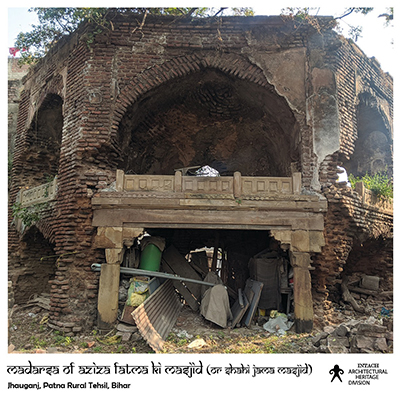
Madarsa of Aziza Fatma ki Masjid

(or Shahi Jama Masjid)

Jhauganj, Patna Rural Tehsil, Bihar

Built in 1629 by Saif Khan. Being a famous college, it flourished from 1740-48 during the time of Nawab Zain-ud-Din Habiat Jung, who also added a library with rare Persian and Arabic manuscripts. The building is in a ruinous condition and a small new building is built in the complex for the madarsa. The adjoining structures (chhatri, bastions, etc.) in the complex are in a dilapidated state and on the verge of disappearance.

H@R 6/365 Radhabinod Temple of Adhikarys

bldg 1

H@R 6/365

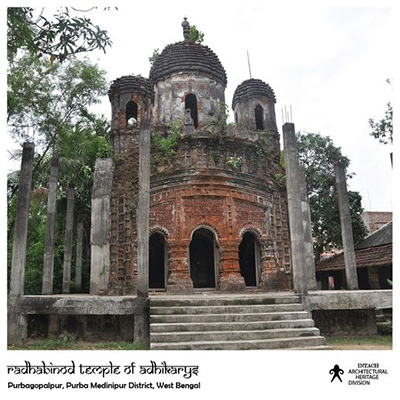
Radhabinod Temple of Adhikarys

Purbagopalpur, Purba Medinipur District, West Bengal

This 1774 CE terracotta temple has severe structural cracks. There is vegetation growth and water seepage in the building. The damaged temple has incompatible RCC additions as a result of a misguided approach, though it may have been well-intentioned.

H@R 5/365 Vernacular homes of Khampti tribe community

bldg 1

H@R 5/365

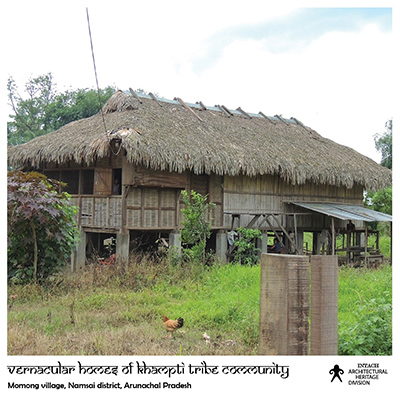
Vernacular homes of Khampti tribe community

Momong village, Namsai district, Arunachal Pradesh

Vernacular architecture is an often neglected typology of unprotected built heritage. This is an example of the wide variety of vernacular built heritage – Hinpha (bamboo house). This is a 100+ year-old vernacular Chang-ghar (stilted house). However, such homes may require rebuilding of some parts after every few years, and this keeps the building tradition and skills alive. These buildings are facing pressures of urbanisation. Vernacular construction materials and techniques are at risk of being replaced with non-contextual contemporary materials. Such as, the traditional mud-plastered cheshmabera walls are being cement-plastered now. Lately, there is use of asbestos or G.I. for roofing.